
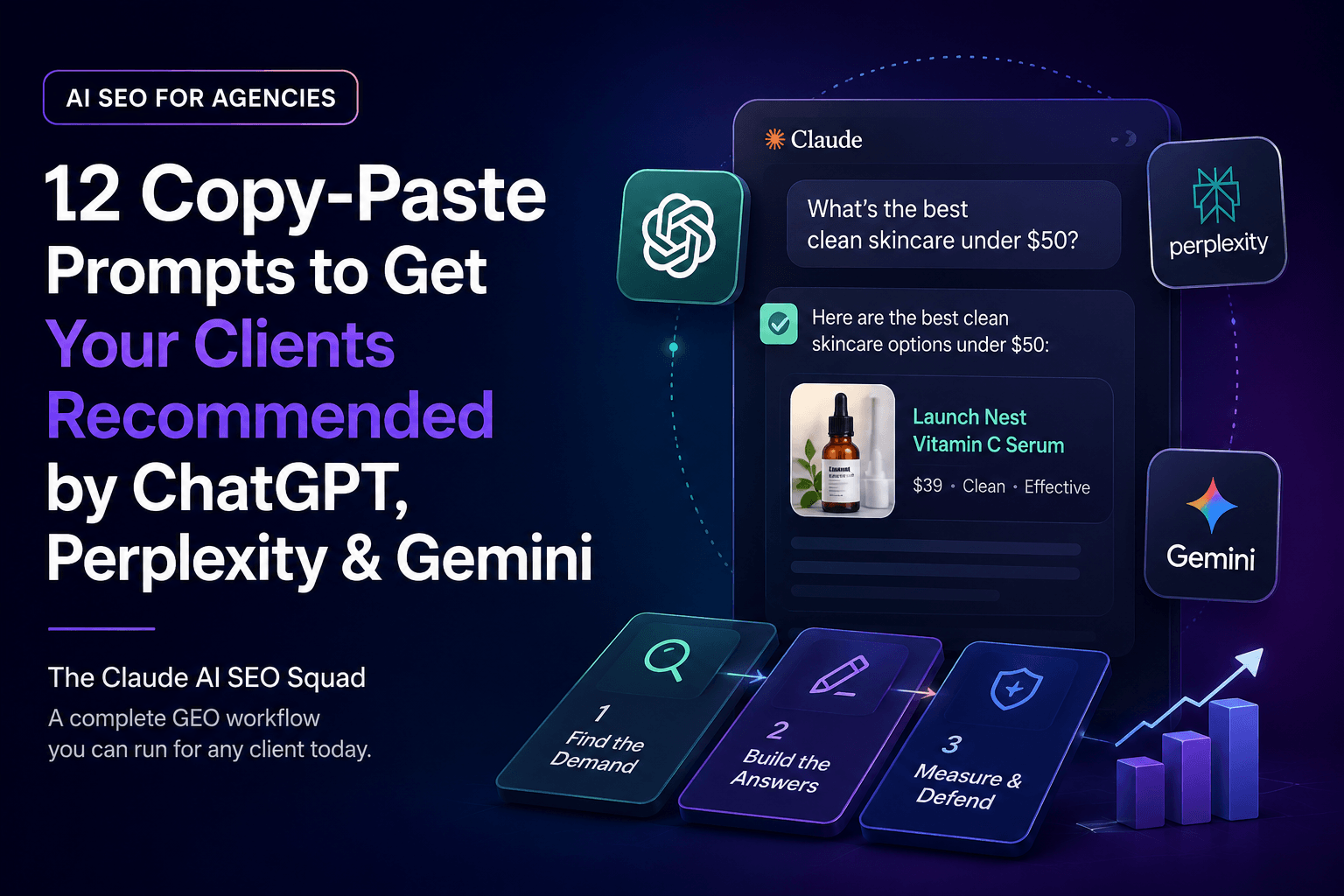
Search didn’t slow down. It split in two.
One half is still the blue links your clients have paid you to chase for a decade. The other half is a buyer typing “best clean skincare under $50” into ChatGPT and getting a named recommendation back, no SERP, no scrolling, no click. If your client’s brand isn’t in that answer, they don’t rank tenth. They simply don’t exist in the conversation.
For agencies and SEO pros, this is both a threat and the clearest growth lane in years. The discipline has a name now, Generative Engine Optimization (GEO), and most of your competitors are still treating it like a buzzword. This post hands you a working system: twelve Claude prompts, each one a specialised AI SEO agent you can run for any client today. No new tools, no subscription, no setup. Paste a prompt, drop in the client’s details, and you’re optimising for AI search before the agency down the road has figured out what GEO stands for.
Here at Launch Nest Studio, this is the exact workflow we run for ecommerce and service clients. Below is the whole squad.
Why This Matters for Agencies Specifically
Traditional SEO deliverables, rank reports, keyword gap analyses, backlink audits, still matter. But they describe a world where the user sees a list and chooses. In AI search, the model chooses for the user. Your job shifts from “rank our page” to “become the source the model trusts enough to cite.”
That changes what you sell. Instead of a monthly ranking report, you can offer an AI Visibility audit, a share-of-voice benchmark against the client’s competitors inside ChatGPT, and a content plan engineered for retrieval rather than keyword density. These are services almost no one in your market is packaging yet, which means margin and differentiation.
The twelve prompts below map cleanly onto a productised GEO offering. Run them in order and you have a deliverable.
How to Run the Squad
You don’t fire all twelve at once. They stack across three phases, and each agent feeds the next.
Phase 1: Find the demand. Agents 1, 10, and 6 tell you what buyers ask AI, what they actually mean, and what the models already cite.
Phase 2: Build the answers. Agents 2, 3, 4, 5, 7, and 8 create and structure content the model can lift, plus the off-site signals that make it trust the brand.
Phase 3: Measure and defend. Agents 9, 11, and 12 track where the client shows up, watch it over time, and benchmark against competitors.
Every prompt uses [BRACKET] placeholders. Replace them before running, and be specific. Vague inputs produce vague outputs, and that’s true tenfold for AI search work.
A note on using these with Claude: paste each prompt into a fresh conversation, fill the brackets, and let it run. For multi-step agents (2, 6, 12), you’ll feed in the output of an earlier agent, so keep those results handy.
Phase 1: Find the Demand
Agent 1: Prompt Research
This replaces keyword research. Instead of guessing at search volume, you map the real questions buyers type into AI on their way to a purchase.
You are an AI search demand researcher for a Shopify brand.

CONTEXT
- Brand: [BRAND NAME]
- What we sell: [PRODUCT CATEGORY + 2-3 hero products]
- Ideal customer: [WHO THEY ARE, e.g. "women 25-40 buying clean skincare"]
- Price positioning: [budget / mid / premium]

TASK
Generate 40 prompts a real buyer would type into ChatGPT, Perplexity, or
Gemini during their journey from problem-aware to ready-to-buy.

Organize them into 4 stages:
1. Problem-aware ("why is my X doing Y")
2. Solution-aware ("best way to fix X")
3. Product-aware ("best [category] for [use case]")
4. Brand/comparison ("[competitor] vs alternatives", "is [brand] worth it")

For each prompt, add:
- Buyer stage
- Whether a brand recommendation would naturally appear in the AI answer (Yes/No)
- Priority for us to win it (High/Med/Low) based on purchase intent

Output as a table sorted by priority. Flag the 10 we should target first.
Agency tip: The “Yes” rows are where visibility turns into revenue, because those are the prompts where AI names a brand. Those flagged ten become your client’s battleground list and the spine of the whole engagement. Run this once per product line.
Agent 10: Intent Mapping
A prompt and its real intent are rarely the same. This agent decodes the job-to-be-done behind each query so your content answers the decision, not just the words.
You are a search intent analyst for AI search.

CONTEXT
- Buyer prompts (paste 10-20 from Agent 1): [PASTE]
- Brand: [BRAND NAME]

TASK
For each prompt, decode the true intent so we answer what the buyer means,
not just what they typed.

For each prompt give:
1. Surface intent (what they literally asked)
2. Underlying job-to-be-done (what they're really trying to decide or solve)
3. The answer format that satisfies it (how-to, comparison, recommendation,
   reassurance, spec lookup)
4. What we'd need to include for AI to consider our answer complete
5. The risk if we answer the literal question but miss the real intent

Output as a table, then a 3-bullet summary of the intent patterns you see.
Agency tip: Thin content answers the literal question and misses the decision underneath. AI rewards the source that resolves the whole job-to-be-done, so this step quietly determines whether the content you commission actually wins citations.
Agent 6: Answer Intelligence
Before you build anything, see what AI already cites for your target questions and why. This is competitor analysis for the answer layer.
You are an AI answer analyst.

CONTEXT
- Target buyer question: [QUESTION]
- The current AI answer (paste what ChatGPT/Perplexity/Gemini returns,
  including any cited sources): [PASTE]

TASK
Reverse-engineer why these sources got cited and how we can displace them.

1. List each cited source and what role it played in the answer
   (definition, data, list, comparison, opinion).
2. Identify the format and angle the AI rewarded.
3. Spot the gaps: what's missing, outdated, or thin in the current answer.
4. Give me a content brief to produce a better source: angle, format,
   the specific facts/structure to include, and what would make AI prefer
   ours.

Output: source breakdown table, then the content brief.
Agency tip: Paste the live AI answer for each high-priority prompt from Agent 1. The sources you’re competing against in AI search are often nothing like the client’s Google competitors, which is exactly the insight that justifies a separate GEO retainer.
Phase 2: Build the Answers
Agent 2: AI Content Strategy
This turns your prompt research into a topical authority map built for retrieval rather than raw keyword volume.
You are an AI SEO content strategist for a Shopify brand.

CONTEXT
- Brand: [BRAND NAME]
- Category: [YOUR CATEGORY]
- Target buyer prompts (paste 10-15 from Agent 1): [PASTE]
- Pages we already have: [LIST URLs OR TITLES]

TASK
Build a topical authority map that makes LLMs see us as the go-to source
in our category.

1. Group the prompts into 4-6 topic clusters.
2. For each cluster, define ONE pillar page and 3-5 supporting pages.
3. For each page, give: working title, the buyer question it answers,
   the format AI prefers for that question (definition, list, comparison,
   step-by-step, FAQ), and an internal-link target.
4. Mark which pages we already have vs need to create.
5. Rank the missing pages by impact on AI visibility vs effort to produce.

Output as a cluster-by-cluster outline plus a prioritized build list.
Agency tip: AI engines reward sources that cover a topic completely. Build the pillar first, then the supporting pages, then link them tightly. This is your content calendar for the next quarter, generated in one pass.
Agent 3: GEO On-Page
Take any page and rewrite it so an LLM can extract a clean, quotable answer while it stays useful for a human.
You are a GEO (Generative Engine Optimization) editor.

CONTEXT
- Target buyer question: [THE QUESTION THIS PAGE SHOULD WIN]
- Current page content (paste it): [PASTE FULL TEXT]
- Brand: [BRAND NAME]

TASK
Rewrite this page so an LLM can pull a clean, quotable answer from it while
keeping it useful for a human.

Apply these GEO rules:
1. Open with a direct 40-60 word answer to the question (the "liftable" block).
2. Use a clear H1 phrased as the buyer's actual question.
3. Break the body into H2s that each answer one sub-question.
4. Add a short definition near the top if the topic needs one.
5. Use specific numbers, named entities, and dates AI can cite.
6. Cut hedging and filler that dilutes the answer.
7. End with a 3-5 question FAQ in Q/A format.

Output: the full rewritten page, then a 5-bullet summary of what changed
and why each change helps AI extraction.
Agency tip: The opening 40-60 word block is the single highest-leverage change you can make on a page. That’s the chunk ChatGPT and Perplexity lift word for word. Nail it and you get cited.
Agent 4: Answer Optimization
Format any answer so AI prefers yours over a competitor’s, then A/B the phrasing.
You are an answer-formatting specialist for AI search.

CONTEXT
- Buyer question: [QUESTION]
- Our draft answer or key points: [PASTE]

TASK
Restructure this into the format LLMs are most likely to lift and cite.

1. Write the canonical answer in 2-3 sentences, lead with the conclusion.
2. Follow with a scannable structure (numbered steps, or a bulleted list,
   or a small comparison table) that supports the answer.
3. Add one "why this matters" sentence with a specific stat or fact.
4. Strip any phrasing that hedges, rambles, or buries the point.
5. Give me 2 alternative phrasings of the canonical answer so I can A/B
   which one gets picked up.

Keep it factual. Do not invent stats. If a number is needed and I didn't
provide one, leave a [INSERT STAT] placeholder.
Agency tip: Run this on the answer blocks from Agent 3. Different engines favour different formats, so the alternative phrasings let you test which one wins citations across ChatGPT, Perplexity and Gemini.
Agent 5: Schema & Structured Data
Generate copy-paste JSON-LD that removes ambiguity from product and content pages.
You are a structured data engineer for a Shopify store.

CONTEXT
- Page type: [Product / Collection / Article / FAQ / Homepage]
- Page details (paste key info: product name, price, reviews, specs, or
  article title and key Q&As): [PASTE]
- Brand: [BRAND NAME]
- Site URL: [URL]

TASK
Generate valid JSON-LD schema for this page that strengthens how AI engines
and Google understand it.

1. Choose the right schema types (Product, Offer, AggregateRating, FAQPage,
   Article, Organization, BreadcrumbList) for this page.
2. Output ready-to-paste JSON-LD with my real values filled in.
3. Only include fields I have real data for. No invented ratings or prices.
4. Add a short note on where to place it in the Shopify theme and how to
   validate it.

Output the JSON-LD in a code block, then the placement/validation note.
Agency tip: Schema won’t rank a page on its own, but it removes ambiguity. When AI can parse price, rating and specs cleanly, it’s far more likely to surface the brand in a product recommendation. Always validate before you ship.
Agent 7: Citation Builder
Build the digital PR hit list of publications AI quotes in your client’s category.
You are a digital PR strategist focused on AI citations.

CONTEXT
- Category: [YOUR CATEGORY]
- Target buyer questions: [PASTE 5-10 FROM AGENT 1]
- Sources AI currently cites (from Agent 6, if you ran it): [PASTE]

TASK
Build a citation-acquisition plan. AI engines disproportionately cite a small
set of trusted publications and listicles. I want to get into them.

1. List the types of pages AI tends to cite for my category (best-of
   listicles, review sites, niche publications, forums, comparison pages).
2. For each, give the realistic path to get included (pitch, product
   submission, expert quote, HARO-style source request, partnership).
3. Draft a 3-sentence outreach pitch I can adapt for editors and list owners.
4. Prioritize the targets by how often AI is likely to cite them vs how hard
   they are to land.

Output: a target table sorted by priority, plus the pitch template.
Agency tip: Getting a client into one frequently-cited listicle can move AI visibility more than ten of their own blog posts. This is where your off-site and outreach team earns their keep, repurposed for the AI era.
Agent 8: Entity Signals
Make AI confidently recognise the brand as a trusted entity in its category.
You are an entity SEO specialist.

CONTEXT
- Brand: [BRAND NAME]
- Site: [URL]
- Category: [YOUR CATEGORY]
- Where we already exist online (paste links: Wikipedia, Crunchbase, socials,
  press, review sites): [PASTE OR "not sure"]

TASK
Build an entity-strengthening plan so LLMs confidently associate our brand
with our category.

1. Audit our likely entity gaps (inconsistent name/NAP, missing knowledge
   panel, thin About page, no sameAs links, weak third-party presence).
2. List the specific assets that build entity trust for an ecommerce brand,
   ranked by impact (Organization schema with sameAs, consistent brand
   description everywhere, founder/brand presence on authoritative sites,
   structured About page).
3. Give me the exact brand description (50 words) to use consistently across
   every profile, so AI sees one coherent entity.
4. Output a prioritized action checklist.
Agency tip: AI trusts brands it can identify without ambiguity. One consistent 50-word brand description across every profile, plus a clean Organization schema with sameAs links, often does more than a traditional link-building campaign.
Phase 3: Measure and Defend
Agent 9: AI Visibility Audit
Get a clear, repeatable read on whether the client shows up across every major engine.
You are an AI visibility auditor.

CONTEXT
- Brand: [BRAND NAME]
- Category: [YOUR CATEGORY]
- Priority buyer prompts: [PASTE 10 FROM AGENT 1]

TASK
Give me a manual test protocol to check our visibility across ChatGPT,
Perplexity, Gemini, and Google AI Overviews.

1. For each priority prompt, tell me exactly what to type and what to look for
   (are we named, are we cited, what position, who's named instead).
2. Build a scoring rubric: 0 = not mentioned, 1 = mentioned, 2 = recommended,
   3 = top recommendation with citation.
3. Give me a results table template to log each engine x prompt score.
4. Tell me how to read the results: which gaps signal a content problem vs an
   entity/authority problem.

Output: the test protocol, the rubric, and the results table template.
Agency tip: This is a sellable deliverable on its own. Run it at the start of an engagement for a baseline, then monthly to show movement. Manual testing works, but it gets slow and subjective fast across dozens of prompts and four engines, which is the exact problem dedicated tracking tools like Ravan Studio automate. You can pull a brand’s Visibility Score in about 60 seconds for free, then decide whether to run the manual protocol or let a tool handle the repetition.
Agent 11: AI Search Tracking
Design a lightweight monthly system to watch how brand mentions shift over time.
You are an AI visibility tracking system designer.

CONTEXT
- Brand: [BRAND NAME]
- Competitors: [LIST 2-4]
- Priority prompts: [PASTE 10-15 FROM AGENT 1]

TASK
Design a repeatable monthly tracking process I can run myself.

1. Define the tracking set: which prompts, which engines, how often.
2. Build a logging template (date, engine, prompt, are-we-mentioned,
   position, competitors mentioned, sources cited, notes).
3. Define the 3-4 metrics to watch (mention rate, recommendation rate,
   share-of-voice vs competitors, citation count).
4. Tell me how to spot a real trend vs noise across months.
5. Give me a simple monthly review checklist to decide what to fix next.

Output: the tracking process, the logging template, and the review checklist.
Agency tip: Visibility moves week to week as models update and competitors publish. A simple monthly log beats guessing and gives you something concrete to report. If running it by hand across every client doesn’t scale, that’s where an automated weekly report earns its place in your stack.
Agent 12: Competitor Share-of-Voice
See who AI recommends in the category, who’s gaining, and where the open ground is.
You are a competitive AI search analyst.

CONTEXT
- Brand: [BRAND NAME]
- Competitors: [LIST 3-5]
- Priority buyer prompts: [PASTE 10 FROM AGENT 1]
- AI answers you've collected (paste any from Agent 6/9): [PASTE]

TASK
Analyze competitive share-of-voice in AI search and find where we can win.

1. For the prompts and answers I pasted, tally how often each brand is named
   or recommended (share-of-voice estimate).
2. Identify what the leaders are doing that earns the recommendation
   (content depth, citations, schema, entity strength, reviews, third-party
   presence).
3. Find the prompts where no clear leader exists. These are our fastest wins.
4. Give me a ranked action plan: which prompts to attack first and the
   specific move (content, citation, schema, entity) for each.

Output: a share-of-voice table, the "open" prompts list, and the action plan.
Agency tip: The prompts with no dominant brand are gold. Those are the questions where a focused push gets your client named by AI in weeks rather than months. Start there, show the early win, then expand the scope.
Putting It Together as an Agency Offering
Run end to end, these twelve agents are a complete GEO engagement: research (1, 10, 6), build (2, 3, 4, 5, 7, 8), and measure (9, 11, 12). You can package that as a one-off AI Visibility audit, a quarterly content-and-citation sprint, or an ongoing retainer with monthly tracking reports.
The window is open precisely because most agencies haven’t moved yet. The clients who get named by ChatGPT and Perplexity in the next year will be the ones whose agencies started treating AI search as a discipline rather than a talking point. These prompts are how you start this week.
If you’d rather have the measurement layer automated while you focus on the build, Ravan Studio scores a brand’s AI visibility across engines in about a minute, free. And if you’d like a partner to run the full squad on a client’s store, that’s exactly the work we do at Launch Nest Studio. Get in touch.
Launch Nest Studio is an Adelaide-based digital agency specialising in web design, SEO, and AI visibility strategy. We help brands get found in search, including the AI search engines now shaping how people buy.