


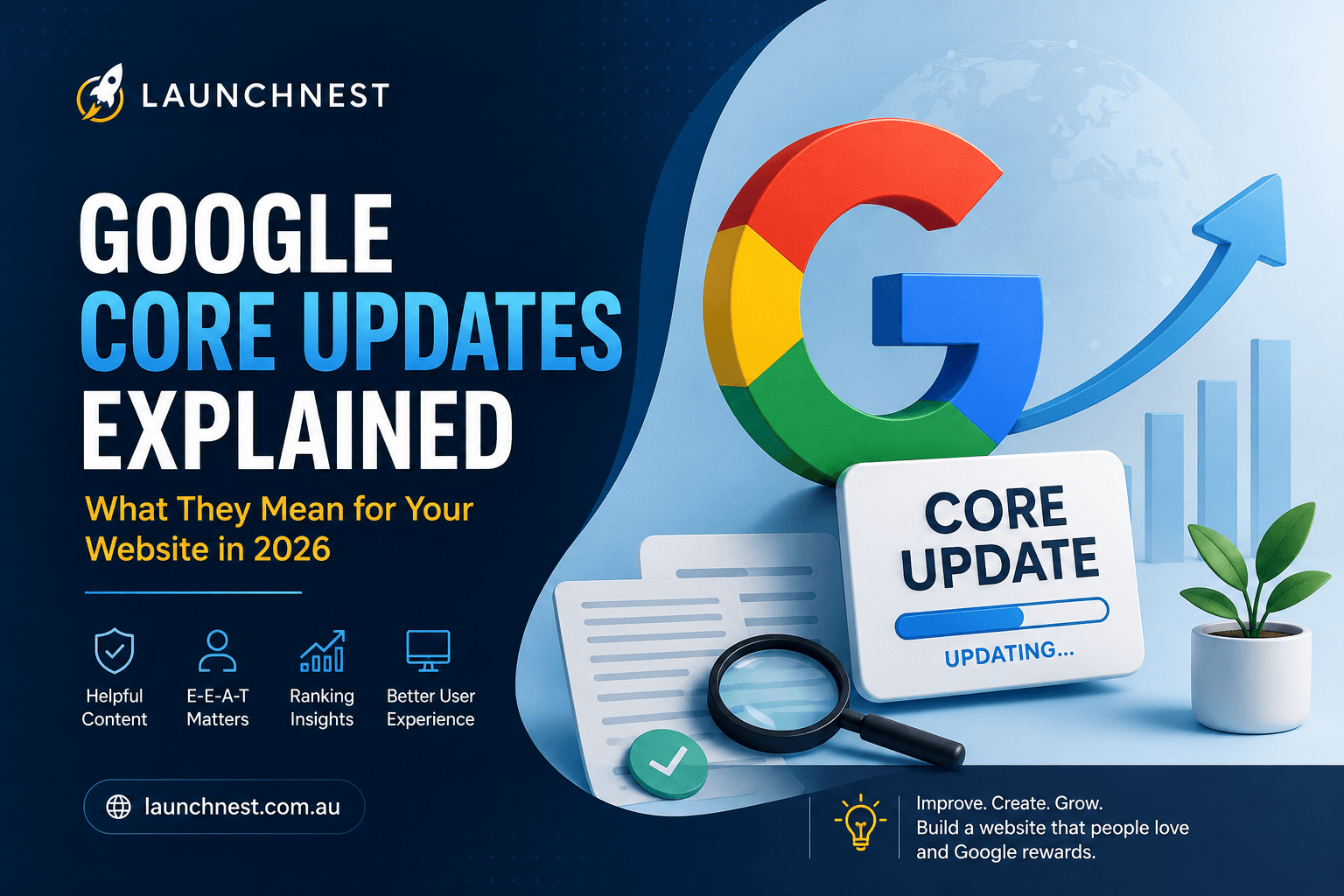
Google rolls out several core updates every year, and each one can significantly impact website rankings, traffic, and online visibility. When a new update launches, business owners often panic after seeing fluctuations in Google Search Console or analytics.
The reality is that most websites aren’t being “penalized.”
Instead, Google is constantly improving its ability to identify and rank the most helpful, trustworthy, and relevant content for users. According to Google, core updates are broad improvements designed to ensure searchers receive the best possible results for their queries.
In this guide, we’ll explain what Google Core Updates are, how they affect rankings, and what your business should do to stay ahead.
What Is a Google Core Update?
A Google Core Update is a significant change to Google’s ranking systems and algorithms.
Unlike spam updates or manual penalties, core updates don’t target specific websites. Instead, Google reassesses how content should be ranked across the entire web to better serve user intent.
Think of it like updating a list of the best restaurants in a city. A restaurant that drops from #3 to #8 isn’t necessarily worse than before; newer or more relevant options may simply have become stronger contenders. Google uses a similar approach when evaluating websites.
Why Do Rankings Change After a Core Update?
Google’s goal is simple:
- Deliver more helpful content
- Reward expertise and trustworthiness
- Better satisfy user intent
- Improve overall search quality
As Google’s understanding of content improves, rankings naturally shift.
Many website owners assume a ranking drop means they’ve done something wrong. However, Google states that a decline after a core update doesn’t automatically indicate a problem. Often, competing pages may simply provide a better experience or more useful information.
The Shift Toward Helpful, People-First Content
Over the last few years, Google’s updates have increasingly focused on rewarding content created for humans rather than search engines.
Google specifically recommends creating content that:
- Demonstrates genuine expertise
- Provides original insights
- Solves real user problems
- Delivers value beyond what’s already available online
- Leaves readers feeling satisfied with the answer they received
This is commonly referred to as “people-first content.”
Businesses that publish content solely to attract traffic often struggle after major updates, while brands that consistently help their audience tend to perform better over time.
Understanding E-E-A-T
One of the most important concepts behind modern SEO is E-E-A-T:
Experience
Has the author actually used the product, service, or process being discussed?
Expertise
Does the content demonstrate deep knowledge of the topic?
Authoritativeness
Is the website recognized as a trusted source within its industry?
Trustworthiness
Can users rely on the information provided?
Google has repeatedly emphasized that trust is the most important component. The other factors contribute to building that trust.
For businesses, this means showcasing real-world experience, client success stories, case studies, author credentials, and transparent company information.
How Core Updates Impact Business Websites
If your business website experiences ranking volatility during a core update, you may notice:
- Changes in organic traffic
- Keyword ranking fluctuations
- Reduced visibility for specific pages
- Improved visibility for stronger content
Google recommends waiting until the update rollout has fully completed before making major decisions. Rankings can fluctuate multiple times during the rollout period.
Instead of reacting immediately, review:
- Which pages gained or lost visibility
- Which search queries were affected
- Whether competitors are providing better answers
- How well your content meets user expectations
Common Mistakes Website Owners Make
After a ranking drop, many businesses rush into making drastic changes.
Google specifically advises against quick-fix SEO tactics such as:
- Removing content without analysis
- Excessive keyword optimization
- Rewriting pages purely for rankings
- Chasing algorithm rumors
- Making large-scale changes during rollout periods
These reactions often create more problems than they solve.
What Google Actually Wants
Google’s documentation provides a simple framework for evaluating content.
Ask yourself:
Who created this content?
Are authors clearly identified? Can users understand who is providing the information?
Is the process transparent? Are facts, examples, and sources clearly explained?
How was this content created?
Why was this content created?
Was it created primarily to help users or simply to rank in search engines? Google considers this the most important question.
The Role of Website Experience
Content quality alone isn’t enough.
Google’s systems also reward websites that provide a strong overall user experience. This includes:
- Fast loading speeds
- Mobile responsiveness
- Easy navigation
- Secure browsing
- Clear design and structure
A great website experience supports helpful content and improves user satisfaction.
This is why businesses should treat SEO, content, and web development as connected disciplines rather than separate strategies.
How LaunchNest Helps Businesses Stay Ahead
At LaunchNest, we build digital experiences designed for long-term growth, not short-term algorithm tricks.
Whether you’re launching a startup or scaling an established business, our team combines:
- Professional Web Development
- SEO Strategy
- Brand Identity Design
- App Development
- Digital Growth Solutions
Explore our services:
https://launchnest.com.au/services/
See our latest work:
https://launchnest.com.au/
Our focus is simple: create websites and content that users genuinely find valuable while following Google’s best-practice guidelines.
Final Thoughts
Google Core Updates aren’t designed to punish websites. They’re designed to improve search quality.
The businesses that consistently win are the ones that focus on:
- Helpful content
- Real expertise
- User experience
- Trust and credibility
- Long-term value creation
If your website is built around helping people first, you’ll be aligned with the direction Google continues to move.
Rather than chasing every algorithm update, focus on becoming the best answer for your audience, and the rankings will often follow.